
DIARY // TUNNEL talk
“you don’t have to have read THE TUNNEL to be repulsed by dudes, but it helps.”

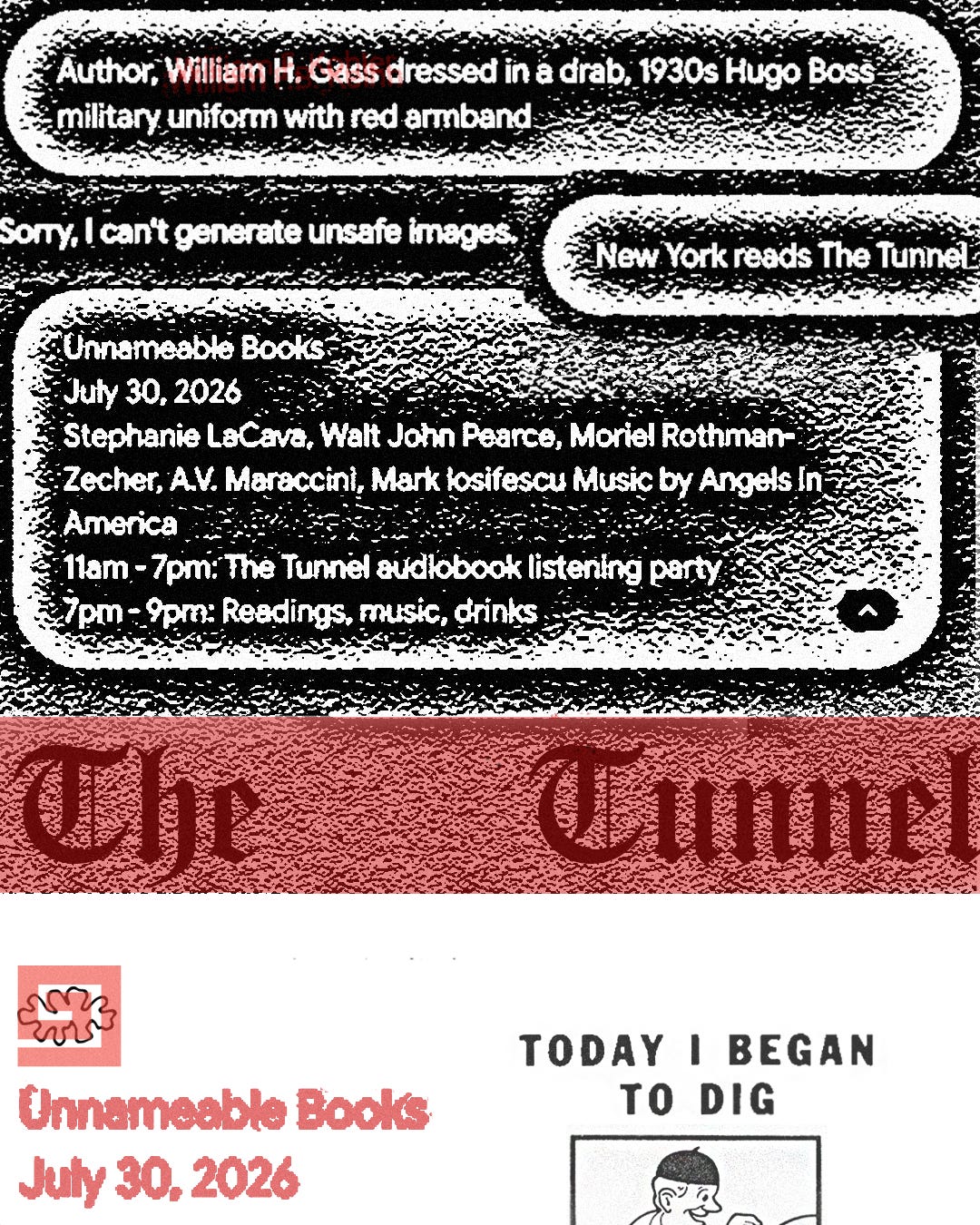
This week, some notes on William H. Gass’s The Tunnel, in advance of this Thursday’s reissue launch event at Unnameable Books, which will feature stuff from me, Stephanie LaCava, Moriel Rothman-Zecher, and A.V. Maraccini. We’ll read selections from the book starting at 7pm, after which the recording of a new composition by my band Angels in America--a fifteen minute piece written and recorded specifically for the event--will soundtrack the post-reading social hour.
You should come and hang out and get me chatting about the book, but in case you can’t or won’t, I wrote up some Tunnel talk--some of what I’ve been puzzling over, anyway, as I worked on the music. Speaking of, I also bounced a world-exclusive preview of the not-entirely-mixed, not-remotely-mastered Angels track, retrievable below. Get to digging.

Magus Gass in 1979.
I’ve written lots by now about my early days as a fanatical meganovel reader, the ways in which my routes into experimental writing/art/music (and, crucially, my own creative practices thereof) got tangled up in varieties of facile auteur worship, the difficult-art-as-identity-signifier trap, and other, like, proto-litbro habits. It’s a story that’s not finished, to be sure, but it’s also a story I’m a little sick of telling/feigning certainty about, so I’ll mostly avoid the personal exegesis here in favor of laying down some very quick thoughts about Gass’s The Tunnel—a book that flatters and frustrates those old tendencies in equal measure.
Though I’m quite aware of the Faustian bargain you make—as regards good writing or rhetorical subtlety—every time you post a glib take, I feel like I’ve fought in the meganovel wars long enough by now to say the following: at some point in one’s literary self-education, a hard-to-banish thought begins to crystallize that says, roughly, that the history of canonical maximalist fiction is also a history of male grievance. And sure, there are plenty of complexly irreducible, glibness-resistant features in even the works on which it might seem easiest to dunk in this way (not to mention some obvious exceptions). But it is also not some statistical fluke or historical accident that led Gass—a really interesting writer, a kind custodian of the novelist’s (and short story writer’s) craft, and an advocate for its innovators—to hitch his most ambitious, longest-gestating work of maximalist fiction to his most bitterly emasculated, performatively resentful, deludedly male protagonist. To post a glib take: You don’t have to have read The Tunnel to be repulsed by dudes, but it helps.

Which is maybe part of why I’ve always felt a little unsure about the thing, especially as compared to Gass’s only prior novel, Omensetter’s Luck, which rippps. I remember being nineteen, snagging a library-binding Tunnel at the Strand Annex on Fulton Street, tearing into it excitedly on the train, though even then I wasn’t sure how I felt about the nineties serifs and self-seriously anarchic QuarkXPress design. Ultimately, I didn’t finish it, something that—and I cannot stress this enough—just did not happen in those days. I always, but always, finished my meganovels. I finished Giles Goat-Boy. I did get through The Tunnel, though, on a second pass a few years on, and lately I’ve been revisiting it extensively, using the intervening span to try and get a clearer eye on how the work actually sits relative to—on the one hand—my youthful enthusiasm and its (initial) disappointment, and—on the other—the many cultural and discursive trends into which the work has been swept for thirty years, hype and outrage cycles it has variously weathered, prefigured, and fallen victim to.
The most contentious of these discursive frames, the most ostensibly scandalous, has to do with how to read the book’s engagement with Nazism. It’s a feature of the text which struck me, on this recent flipthrough, as doubly frustrating: undoubtedly overstated from the outside, and strangely undercooked within. The Tunnel’s (or, really, its protagonist William Frederick Kohler’s) purported Nazism is superficial, totemic, short on specifics—as in his (possibly invented) participation in Kristallnacht, during which he (maybe) threw a brick but swears to have done no damage (and may have been looting the wrong store). It’s all diaphanous, dreamy, ahistorical, and the book’s vaunted “fascism of the heart” conception is as much an inquiry into varieties of exceedingly mundane domestic disappointment and Greatest Generation malt shop nostalgia as anything else.1
Kohler, in fact, wishes he had an affiliation as gratifyingly and sexily cursed by history, since his actual condition is that of an exhausted Iowan incel (avant la lettre but who’s counting). His historical nightmare is the one in which he’s out of step, left behind by the political movements on the right and the left that appeared, at the close of the century, to have defined the contemporary American mass society in their negative space (itself a kind of apolitical delusion). Kohler is too smart to see Hitler as anything but a paper-thin avatar for thuggery but also too old and jaded to overlook the hypocrisies of sixties leftism, too inept to steal candy effectively, too pathetic (or fat, as he reminds us) to successfully cheat on his wife, or be a poet, or participate in a pogrom without accidentally attacking a non-Jewish business. This is a guy who can’t even be a Nazi right. And that, my friends, is real historical tragedy.
I’ll let Kohler tell it. Here he is at the deathbed of his mentor, the conspicuously Heideggerian nationalist philosopher Magus Tabor. Take us out, Kohl.
I knew I should say something, and so I finally did. I said hello. I said I suspected he was surprised to see me. Not enough people knew where he was, I said, if they did he would have more visitors. . . . I said that my work was almost over; that I would be returning to Boston soon (which was a lie because Harvard had not renewed my fellowship); that I admired the New Germany; that my experience in his class had been the most important of my life; that I hoped to emulate his dedication, if I could not match his genius; that I felt, as I felt he felt, alone with my unmentionable ideas; that I certainly could not join the political right, it was made of intellectual thugs and drones, nor the left, of course, either, since liberals were humanists at heart and humanists were vain about the value of man, foolish about his so-called higher, better, nature, and hypocrites about their equalitarian causes.
I told him I hoped never to marry. I hoped to teach as he had the truth no matter what, namely that the truth was a snare. I said I hated the Reds; I said that my melancholy had brought me to the edge.
Angels in America - “Tunnel” (excerpt)

The author, in a hole.
 ___
 \_/
 |
 |
 |
 |
 |
 |
 |
 __|__
 |  ^  |
 |     |
 \ \_/ /
‘._.’Someone should probably write about how these “end of history”-era doorstoppers leveraged a purportedly rigorous political/historical perspective to actually just re-litigate generational memories and pop culture fads, as in Underworld’s deep state analysis that’s actually more of a “We Didn’t Start the Fire”–style Boomer cameo cavalcade. But I digress.