
DIARY // vollmannomics
“There was, in other words, no way I was gonna survive the historical accident”

Hi! OK:
✰ First: Asphalt Green, the new album by my band Angels in America, is out now on Halcyon Veil. A physical release is forthcoming; meanwhile, listen via DSPs or buy on Bandcamp or check out now nice Boomkat was about it. NYCers, keep your eyes peeled for an event in June which, naturally I’ll be writing about here too. Peggy onlyfans get pushed around.
✰✰ Second: I was too tied up last week to note that I’d be reading on the evening of Thursday, 5/27 at St. Dymphna’s for Kelly Karivalis’s “Limitless Hangout” series, but I did and it was great and all kinds of old friends came out. Thanks to them, to Stephen Piccarella for suggesting me for the bill (and reading a ripper of a story), and to Kelly for letting me hop on.
✰✰✰ Third, and of most direct relevance: issue 7 of The Whitney Review is out, and in it--among the analyses from voices across Whitney Mallett’s typically glittering contributor vanguard including Esra Padgett and Bela's MTV--there is another writeup of mine. This one is on William T. Vollmann’s forthcoming A Table for Fortune, which I read over the first stretch of 2026 to the tune of four PDF volumes, totaling 3,557 pages, in which I made 2,092 marginal notes all while racing against: a review deadline (a generous one, but still); the onrushing birth of a human child; and the ever-present, altogether Damoclean threat of my waking up one day and realizing I didn’t, strictly speaking, actually need to do any of it.
Because OK, to back up: after a 2024–2025 writing season largely spent working up longish-form pieces on Rachel Kushner, Peter Weiss, and Thomas Pynchon, I’d intended to cool out on book reviews, especially ones that required as much in the way of copious research and reading. But also, let’s be the remotest bit real: I’ve known that A Table for Fortune was coming since it was announced in March 2025, and I’ve followed along over the years as the book’s complex and tragic professional and personal contexts have been enumerated. Also, crucially: I’ve been a Vollmaniac since I was a kid, as well as a compulsive achiever with poor time management, as well as one of these maximalist masochists. There was, in other words, no way I was gonna survive the historical accident of my shambolic freelance book reviewer era coinciding with the release of WTV×CIA without at least, like, sending an inquiry or two. Having thus set my own Table for Fortune--albeit this one via a cold-call email to a “publicity@” publisher account--I was, wouldn’t you know it, invited to dine.
My thoughts on the book itself? Those are thankfully complicated enough they don’t lend themselves to pithy one-liner takes, so I’ll refrain from summarizing. I’m happy with the way I got them across in the printed piece, which I’ll likely post here when the book is released in August, though fwiw the text is also reasonably scrutable in the picture I posted. But really you should just order the issue.
Meanwhile, in the vein of prior “DIARY” entries on here, please find some deep background below: notes and contexts and loose-end attempts to account for a small fraction of the many years and man-hours I’ve spent variously reading, deeply admiring, and bristling against the work of thee titan William T. Vollmann.
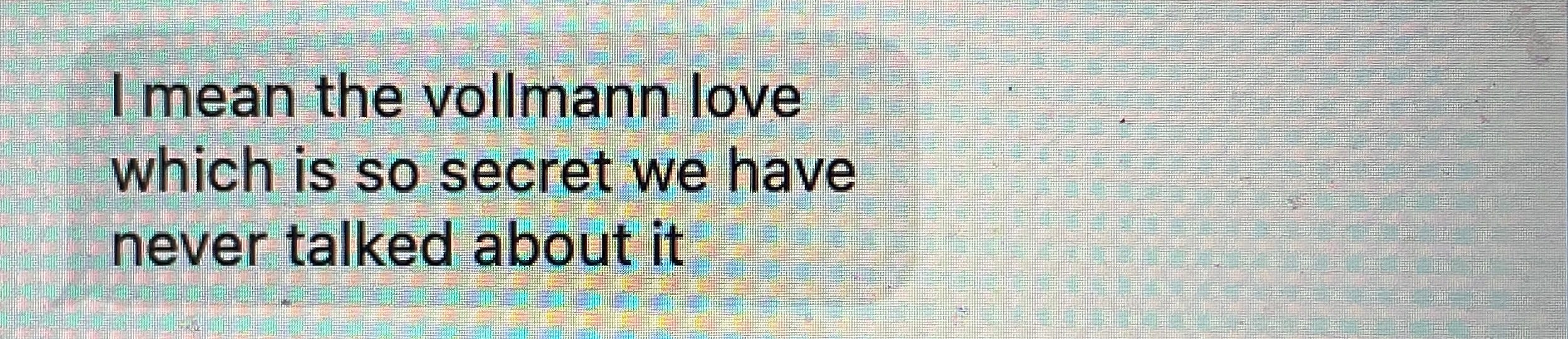
Time for some home truths.
To the extent I’ve thought about it, I’d always assumed that the first Vollmann I read must have been Europe Central, whose April 2005 release lined up neatly with my first cruises into meganovel fandom—about whose mixture of aesthetic thrills and handy identity-crystallizing capacities (I was sixteen) I’ve written before. It turns out, however, that this was a false adolescent memory, similar to the one in which I swear I saw a billboard for Blue Streak 2 (a sequel which, in spite of my certainty, later research has confirmed was never shot, or even greenlit!!). What I’m saying is that I didn’t tackle Europe Central until 2008, a fact attested to in turn by the signed and dated back-page inscription I scrawled in my paperback copy (another story, but at the time I thought this was a cool thing to do). Anyway, my actual first WTV was The Ice-Shirt, and it was revelatory.
It stands to reason that Vollmann’s Seven Dreams books (of which The Ice-Shirt is the first) would’ve been the ones to force open my conception of, among other features, the kinds of narrative experiments and broad political inquiries that were admissible in otherwise straight-faced historical fiction. I was, at the time, writing what I thought was my own transhistorical opus, and I clung to Vollmann’s notion of “symbolic history” and cited it often over the years, sometimes as justification for my own superficial reading or insufficient experience. I’m telling you, this stuff is dangerous for kids!! Because while sure, the “symbolic history” conception is slippery—prone to moral posturing, post-facto wish fulfillment, and a strained sort of circular logic (these unrecorded facts are truer than the recorded ones, because they’re offered in the service of a larger truth, for which you’ll have to take my word)—it also doesn’t function successfully in the absence of the sort of rigorous research and committed participation that underlie WTV’s work. Vollmann, in other words, could take the biggest of thematic swings, tempt clunkiness and preachiness and extreme pagecount indulgences, and get away with most all of it because it was clear he was a lifer: an author demonstrably all in, on every level, and—by way of contrast with my blustery, bluffing youthful example—unwilling or unable to disguise it.

Vollmann ably channeling Céline in the opening of his afterword to the 2006 New Directions reedition of Journey to the End of the Night. Don’t hurt em WTV!!
This would have been an easy enough identification to make on the page, since even WTV’s most strenuously stylized historical excursions contained revealing first-person/fourth-wall-collapsing authorial asides or interludes, decidedly unguarded lists of notes and sources (including plainspoken admissions of whatever was made up), and other markers of an uncommon—if now somewhat ’90s-postmodern-fiction–feeling—forthrightness. The actual means, though, by which I came to understand this crucial aspect of the Vollmann project was in its social implications. As I grew up a bit and began moving into music and art and general freak scenes, I was struck over and over by how the folks I was increasingly mixing with—people whose worldviews were marked by a devotion to marginal culture and a concomitant distrust of consensus reality—seemed to know and love Vollmann: whatever their level of interest in WTV’s grimier gonzo sex and drug excursions, radicals and activists easily spotted him for his fullthroated devotion to the global underclass and commitment to transhistorical justice; whatever their familiarity with his fictional doorstoppers, traveler kids and noisers idolized him for a fellow trainhopping devotee of the extremes of human experience. In the “real recognize real” sense of things, it was abundantly obvious: WTV was one of us, and more.
And so, being some kind of aspiring “real one”—if one necessarily crippled by an adolescent self-consciousness comparable to, say, WTV’s own in his delightful Deep Springs essay—I mainlined the books, lots and lots of them (though not all, which for some reason feels characteristic too). I sought out rare Vollmannabula and got overdue notices for the full Rising Up and Rising Down set (shouts out Smith College Library). I named a song after his book on gender and desire in Noh theater. And I logged and stashed away favorite bits of the body of work, vivid and affecting sections to which I often return: the “Catacomb Thoughts” opening of Rising Up and Rising Down; the treacherous Alaskan river crossing in An Afghanistan Picture Show; the Zoya Kosmodemyanskaya chapter of Europe Central; the death of Looking-Glass in The Dying Grass (and that book’s all-timer onomatopoeia “shlak,” denoting the cries of the Nez Perce babies).
I also grew, over time, into a state of real discomfort with other, less mythologized aspects of the WTV legend. There are the easy layups for cultural/sexual exploitation and poverty tourism; the queasymaking GenXer provocation games (so much to choose from, but let’s just go with the Captain Subzero stuff in The Rifles as representative); and, on the level of writing, such compulsions as the endless metaphorizing of the female body as a stand-in for good and ill, a sometimes strikingly willful inelegance, and a general moralizing streak that’s perhaps unavoidable when you’re making, like, multi-volume inventories of human failings, but still. Like I said, easy accusations—and ones complicated by the Vollmann voice’s blend of semifictional experiments and warts-and-all journalistic candor—but they’re there, and they’re increasingly unignorable, and you don’t need to be a scold or some stooge of kneejerk cultural ostracism to acknowledge that they merit more discussion than they’ve gotten.
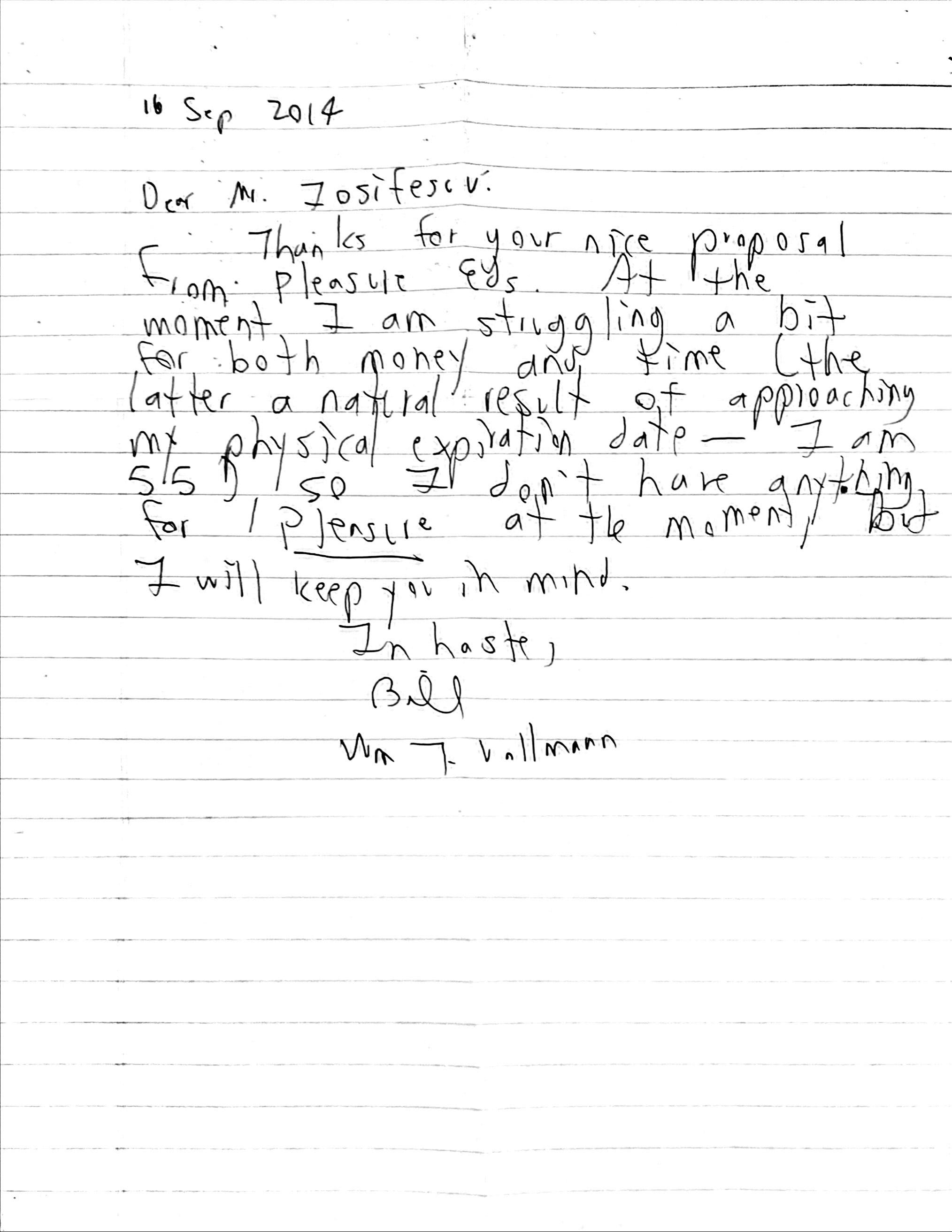
In 2014, when I was working up what would become the final edition of our zine PLEASURE—an issue dedicated to the maximalist impulse that eventually featured contributions by (or on) James McCourt, Steven Moore, Baron Corvo, and Marguerite Young—I was lucky and crafty enough to trade on a former high school frenemy’s internship at Viking and get an inquiry out to Vollmann via his agent: specifically, a package sent to her office and forwarded on to WTV in Sacramento. Did he want to contribute something? I laid it on thick, I’m sure, as we did in those days when we were courting our heroes (hey, it worked on Costes).
A month or so later, I got a charming rejection letter, likewise blind-forwarded via the agency. “At the moment,” Bill wrote, “I am struggling a bit for both money and time (the latter a natural result of approaching my physical expiration date—I am 55).” He signed it, “In haste.” I folded the letter and tucked it into my copy of the abridged Rising Up and Rising Down, which I’ve been known to pull down every once in a while. And though we never interacted again, I feel the furthest thing from disappointed about WTV’s demurral. He was busy, surely, and probably even more earnest about the mortal dimension than I gave him credit for at the time, when I’d just assumed he was joking. He would, after all, have already been working on A Table for Fortune.
I think the new album is great. I have font memories of y’all playing Baltimore back in the dayyyys if you tour you should come back through
Glad to see some people are already making it to the other side of TFF! I'll keep an eye out for your review!