MUSIC // “asphalt green” notes
another in a long line of releases whose genre can best be described as “defeated power-chord”

This week, one last bugle blast over the appearance of Asphalt Green, the first album by my band Angels in America to be released since 2019. The record is out now on Halcyon Veil, a development we’ll be celebrating this evening (June 23) with a listening session at Night Club 101, to be followed by a proper label showcase featuring sets from $quib and Patch+. We’ll also have sick original Asphalt Green posters by Madeleine Kunkle on hand.
Also: we recorded a segment for Montez Press Radio’s latest series “The Walk,” in which Esra Padgett and I bopped around the neighborhood with our tiny babies and talked about the album’s genesis. If you’re interested in, say, doubly embedded Blue Öyster Cult references or the truth about whether we crashed our grandma’s car on our first tour, the segment is streamable on the Montez site.
But OK, while I like a hype cycle as much as the next guy, I’m pretty sure there’s only so much yakking you can do about a record in mediums aural, textual, and IRL. Still, today I test the hypothesis one more time by offering a few words on the origins and purpose of each of Asphalt Green’s tracks. In other words, we’re kinda in heads-only territory--and even then, you might have something better to do. But since that’s the kind of thing no one can ever know for sure, you might as well read on.
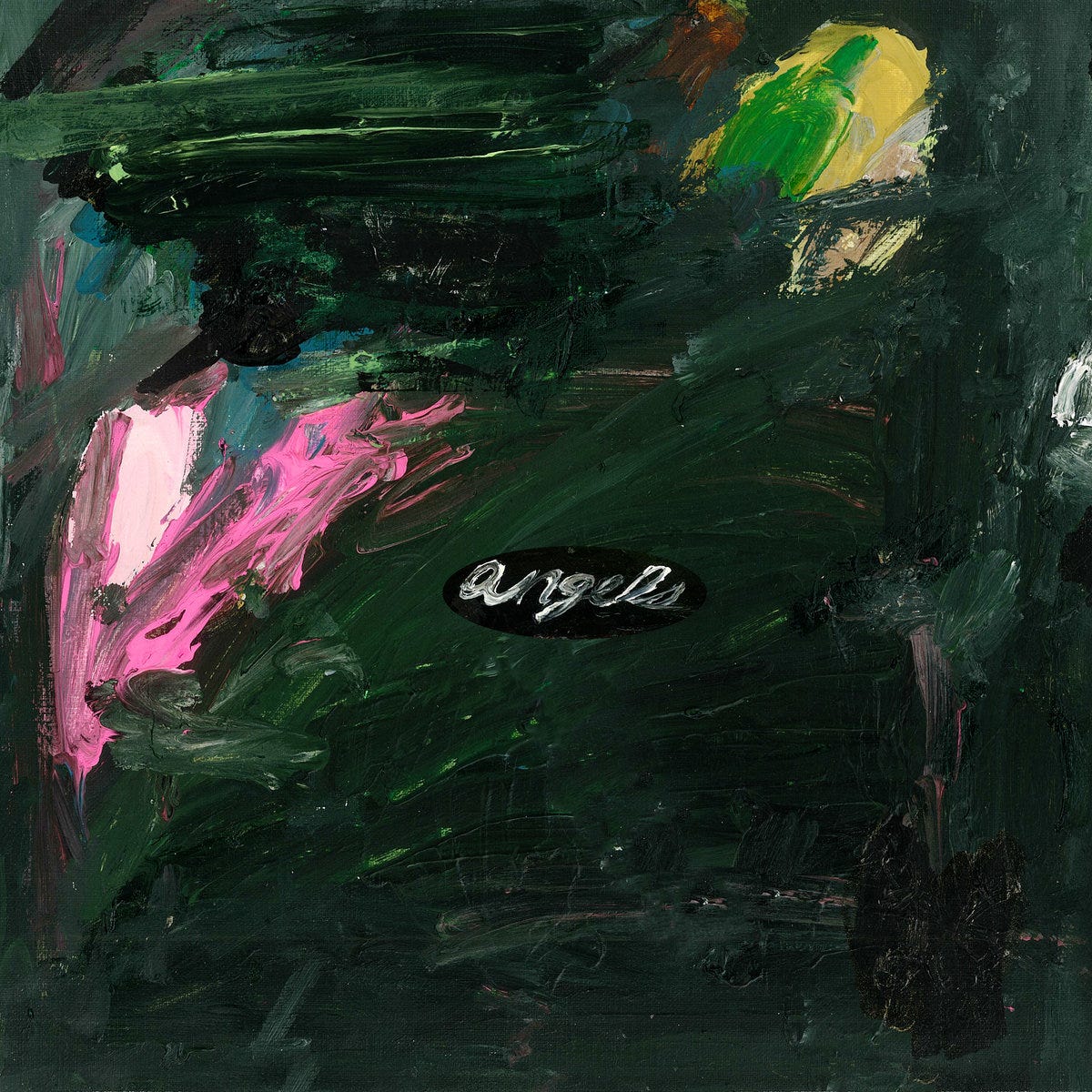
Album art by Chloé Maratta.
1. “No Bluff”
We played a rudimentary iteration of this one on tour with Odwalla1221 in 2018—that version was all softsynths, loud bangs, digital artifacts, but we knew this song was actually another in a long line of releases whose genre can best be described as “defeated power-chord.” Once around 2014 I was sitting around at Red Light District reading the late-period issue of Cometbus in which he goes back on tour with Green Day in China, and Brian Narwhalz said something like, “Hey, Green Day in China; that’s like your music, Mark.” And while I wouldn’t know how to make a legitimately pentatonic decision, I flash on it every so often. But OK, anyways: we recorded “No Bluff” in 2020 with the genius Emil, who engineered and co-produced and added several brilliant textural details including but not limited to the moments of aux percussion on the highly celebrated line “My nurse is wet,” and of course the big whooosh when Esra says “passenger pigeon, Park Ave Armory.” Thank you Emil!
2. “Doubtful Realm”
This song—which is named after Esra’s dad’s WiFi network I think??—was originally conceived as a musically illiterate investigation of the loping guitar figures on the third VU album, which is why we have the gall to quote “Pale Blue Eyes” in it. Kinda stressful when I write it out in plain English. But the end result is its own thing and it’s good as hell and I won’t apologize. One other thing I remember: Esra telling me not to distort the little “solo” lead bit (around 2:40), that sometimes it’s nice to just kinda hang out without getting into a whole volume arms race with yourself for the sake of a cheap crescendo. Goodass call!!
3. “VFW pt. 1”
Nobody knows why, but for a long stretch of this album’s even longer drafting phase, we thought it would be funny or interesting or something to include a couple of “skits” whose theme would be… the Vietnam War?? Like: battle soundscapes, walkie-talkie chatter, helicopter samples. Again, no single person could tell you why this seemed like an OK idea, but eventually we wised up enough to mostly bail (although there is still a little bit of walkie later). Instead, “VFW” became a collaged guitar noise situation, chopped together from a much longer recording. When Jack was mixing, I told him I wanted it to sound like Ride a Dove.
4. “MDF”
This track arrived pretty much fully written from Esra, and while I couldn’t spill too much about her process if I wanted to, I will say there was definitely some One Foot in the Grave–type stuff happening over at her place. We entrapped Daren into talking on the recording, which is the sort of extractive, ethically dubious move we’ve done a lot over the years but have mostly stopped doing. Mostly I remember being really proud of how accurately I played the riff relative to the version I sang in the voice memo that’s played at the beginning on the track, down to key and tempo. Also: the obviously pitch-shifted guitar in the bridge is at least partially my rip of the kazooey lead sound on Accelerator.
5–6. “Pre-K” + “K-Swiss”
I wrote all about “K-Swiss” when the single was released in May, though I’m glad full album listeners now get to hear the short lead-in. Since I already talked about Modest Mouse and the “dickish rocksteady outro,” I’ll just say that for me these tracks hit an ideal of Angels in America guitar tone, namely that it still sounds like we plugged directly into our iBook headphone jack (which used to handle input also, look it up). Light as a feather, stiff as a board. May it always be.
7. “VFW pts 2 + 3”
One extra unfortunate side effect of the already dubious “Vietnam War soundscape” idea was that, when I randomly found a voice memo of myself playing “When the Saints Go Marching In” on a child’s harmonica (playing it haltingly, too, like I was scared to mess up), I was like “Oh, that could probably go in ‘VFW.’” Again, I can’t stress enough how happy I am that we went ahead and jettisoned this whole conceit, but it’s somehow not surprising that something as goofy as a “When the Saints Go Marching In” needledrop carried over. Last summer, one afternoon during my cross-country road trip (this was in the Billings Public Library), I bogarted a computer break I could have using to search for paying work to instead fuck around with a MIDI file until I felt I’d sufficiently detuned the song’s second line stylings. Weird idea.
8. “Time Goes”
In demo form, this was named “Lana,” since I thought the tidy box-step of the vocal melody had a certain “Mariner’s Apartment” vibe to it, I dunno. Luckily we messed it up enough—with Ric Flair and sampled recordings of me sloppily drumming on the practice space kit—so as to smear the reference points a bit (which also, for me, include a half-remembered garage revival number and a Jandek song). I also want to publicly thank Jack for being like, “Wait, should I tune the kick drums to the bassline?”
9. “Angels Online”
The most important song on the record and the one that took the longest. There are maybe a hundred versions of this guy from across five or six years, but some constants: a piano arrangement whose arpeggiated construction I borrowed from the most impressive song I learned to play in 7th grade (after which I never got any better at piano), the line “Peggy only fans get pushed around,” and a world-historical pileup of lyrical references to textbook conspiracies, Montréal punk clubs, and the third BÖC record. Chloé apparently said this is “a song about everything that has ever happened,” which I’m also cool with.