
INTERVIEW // christian staebler + saga de xam pt. 3
“comics weren’t well regarded in art schools. talented artists still rejected them. even comics a͟u͟t͟h͟o͟r͟s despised them.”

This week, the electrifying conclusion of our coverage of Saga de Xam, Nicolas Devil and Jean Rollin’s legendary underground graphic novel whose first-ever English language version I edited for Anthology Editions.
Previous posts have highlighted Saga’s fascinating publication history and the complexities of its translation process, but this time out we’ll be taking a look at the life of the book’s creator, Nicolas Devil (born Deville), and the late-’60s countercultural comics scene that fed the Saga sensibility. To do that, I interviewed Christian Staebler, the writer and artist most directly responsible for Saga de Xam’s renewed life and the foremost authority on the book and its history.
Christian and I first crossed paths in January 2020, when I wrote to him during what had already become a multi-year effort to track down the authors, publishers, or rights holders of the original Saga comic. I had discovered that Christian had interviewed Nicolas Deville in a 2016 issue of the bande dessinée magazine Kaboom (which, in the detective drama that is reissue R+D, constituted a huge break in the case), but I had no idea that he was already working with Deville’s son, Stan, on a restored version of Saga for publication in France. That reissue appeared in 2022, in a handsome edition featuring a new introduction by Christian that served as a definitive account of Saga’s creation, its impact, and the life of its creators. When Anthology Editions was in the process of putting together its English version--during which I came to Christian with numerous questions on everything from translation to color separations--it was a foregone conclusion we’d include a translation of his introductory text.
I spoke to Christian last week via e-mail to celebrate the book’s release and try to kick up some of its lingering mystery.
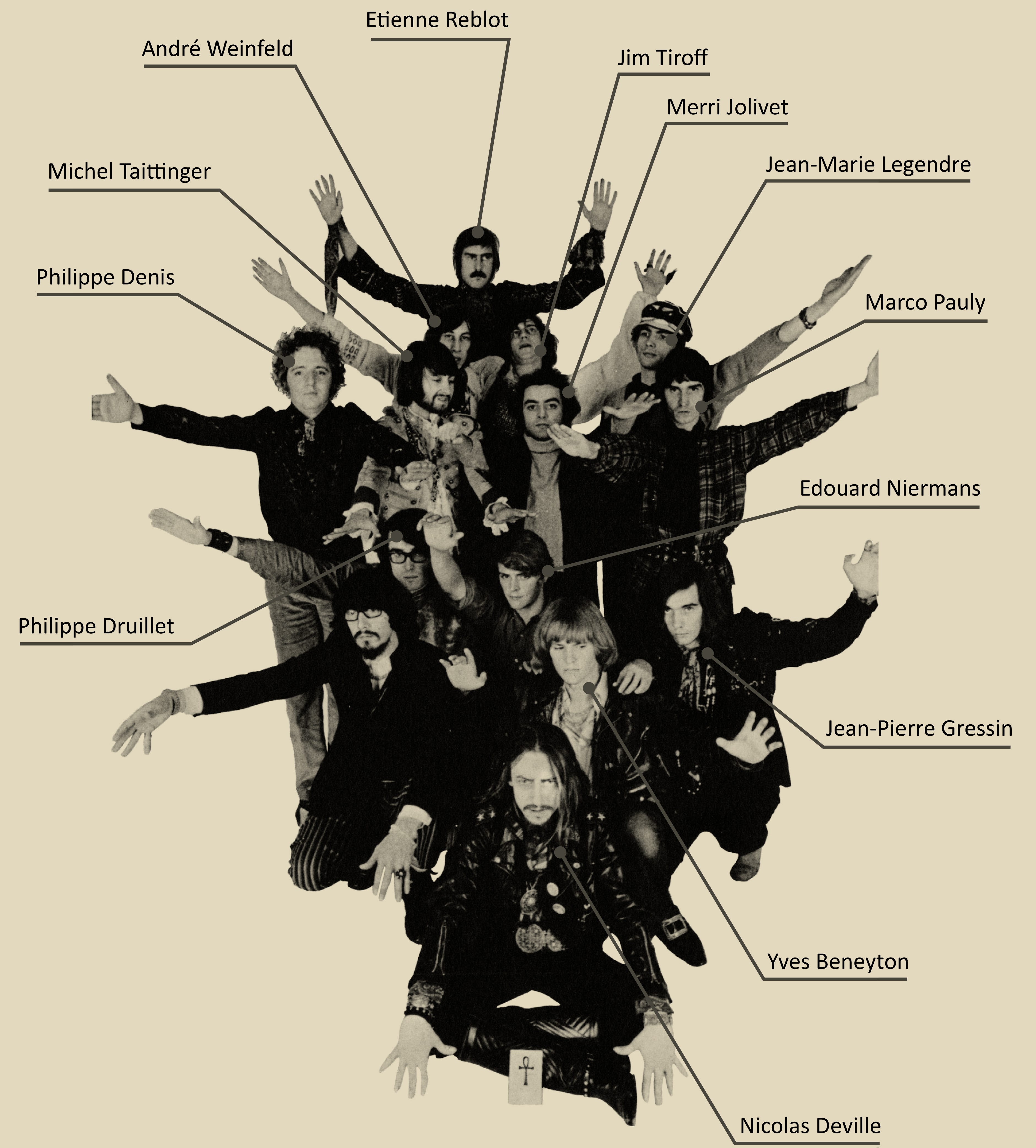
Nicolas Deville with his circle of friends and collaborators, many of whom had a hand in the creation of Saga de Xam. Image legend courtesy Christian Staebler.
What is your history with Saga de Xam and with French underground comics in general? Do you remember the circumstances surrounding your first exposure to Saga?
I have been a comic book fan since childhood, and started reading specialized magazines as soon as they were available in the deep countryside where I lived. In high school I had a history teacher, Mr. Sabatier, who offered optional courses on comics (this was in 1973). It was he who introduced us to Saga de Xam during one of these courses. I was immediately dazzled. I couldn’t stop myself from acquiring a copy, which happened in 1978. I was already writing about comics at the time, and began interviewing cartoonists around 1980.
I searched for Nicolas Devil for a long time without knowing what had become of him. I always hoped that this book would be reissued. In 2014, I finally found his whereabouts in Canada and interviewed him then; he was already a little affected by the Alzheimer’s disease he still lives with. So he also put me in touch with Stan, his son. I asked them about a reissue, but Nicolas told me it would be difficult because all the originals had disappeared or were scattered. That’s when I started to do the restoration… All this is just a labor of love and passion for this book.
As you describe in your introduction, the large and fertile countercultural scene that surrounded Nicolas Deville/Devil at the time he began Saga de Xam--especially the people who lived at or visited his large, commune-like apartment and studio--resulted in conditions very uncommon for the creation of a comic book. The counterculture is also a subject in the story itself: I’m thinking of the scenes at the end featuring protest slogans and psychedelic visuals, not to mention cameos from well-known counterculture figures (Judith Malina and Julian Beck, Brian Jones, Ginsberg etc).
Can you speak a little about how these interests and experiences characterized his work and his career?
Yes, Deville was clearly fascinated by the counterculture that he must have encountered during his time at the Beaux-Arts. He’s been interested in it for his whole life. His second book, Orejona, is an ode to counterculture, a book almost as incredible as Saga de Xam. He told me about it: “It was a very aggressive album, about the quality of civilization, and it was a way to let off steam, if I may say so. After Saga, we lived in a community, and ideas came from everywhere. At that time, we were very anti-establishment. We lived with ideas and we applied them. We always had contempt for money. We didn’t make any money, but we had a lot of fun.” When I interviewed him, he was still hoping to write a sequel.
Then, between 1975 and 1980, Deville illustrated and also contributed writing to a series of books (Tout, Nu, et Nous, the three volumes of Les livres des possibilités, or the “Books of Possibilities”) that were very focused on alternative medicines and alternative ways of seeing the world, in collaboration with André Bercoff and Paule Salomon. Nicolas Deville remained a free spirit and open to all possibilities throughout his life. In Quebec, he made his living as a philosophy professor, but also campaigned for ecology.
Deville was also--like countless avant-garde artists before and since--from a wealthy family, which enabled him to create his work without outside pressures. Additionally, it meant that his large apartment in Paris could serve as a sort of headquarters for the experimental scene of the era. How do you think Deville saw himself in light of these contradictions? Was he aware of being part of a specific artistic lineage along these lines, or was he just pulling from the milieu that surrounded him?
Actually, Deville cited his two major influences during the Saga era: Walt Disney and Robert Crumb. This demonstrates, I believe, his eclecticism.
But yes, he came from a very bourgeois background, although it was also he who surrounded himself with these counterculture figures. This milieu wasn’t his background imposing itself on him; it was a background that he built for himself because he was interested in it. And, of course, having no financial needs, he was able to make his life what he wanted. He explained to me very clearly that at one point, he could have worked for Pilote, which was the weekly magazine for children and later for young adults launched by René Goscinny, the creator of Asterix. It was the most innovative and widely read magazine of this type in the 1960s and ‘70s; it was in Pilote that authors like Jean Giraud (aka Moebius), Philippe Druillet, Jacques Tardi, etc. appeared. But for Deville, the work necessarily involved compromises, which he refused.
That brings us to the way that Deville related to the comics scene specifically, which I find really fascinating since--for all of its loudly countercultural themes--the primary history that’s embedded in Saga de Xam is that of the comics medium itself. The book features work by other major artists like Druillet, of course, but it also has cameos from Captain Haddock, Barbarella, Prince Valiant, and many other preexisting characters from print. What do you think Deville’s relationship was to this tradition, and how common was his attempt to marry the classic comics form with the newer underground?
Well, Nicolas cited his major influences, but he undoubtedly knew the world of comics. He knew Philippe Druillet very well, of course, but also Moebius and many others—I think he even lived in a community with Moebius in the 1980s. But in the 1960s, he could only be a comics fan, because as a student at the Beaux-Arts in Paris, it wasn’t a given. Comics weren’t well regarded in art schools. Talented artists still rejected them. Even comics authors despised them. For instance, Paul Cuvelier, who drew the successful children’s series Corentin—and also produced the famous “adult comic” Epoxy for Saga’s publisher, Éric Losfeld—dreamed only of being a painter. There were many such artists, for whom comics were just a way to make a living. So when an artist got into comics just for fun, the way Deville did, it was because he was passionate about the genre. The various tributes throughout the book are proof: he knew his classics. But his desire to evolve the genre is also evident. This is undoubtedly why he and Druillet got along well during this period. Both saw everything that comics had to offer.
You mention Éric Losfeld, who is an important part of this story of comics--this supposedly lowbrow, vernacular art form traditionally associated with children--being linked with “edgy” and provocative material. He really seems to have been a fascinating character, simultaneously devoted to the books he released but also very strategic in his use of scandal and notoriety to create a niche for his publications.
Éric Losfeld was, we mustn’t forget, a lover of eroticism. We mustn’t forget either that the best way, in the 1960s, to break down constraints and shake up old customs was to liberate sexuality. Of course, this was initially to the advantage of men, who could thus benefit from this liberation of bodies which took place before that of minds. It took time for women to be able to speak more freely and talk about their own feelings, which is why readers born after the 1980s and ’90s may still be shocked by some of the images in the book. But it seems to me that even if scenes are a little “borderline” in today’s eyes, Saga’s message is still clearly in favor of women. For me they are much more powerful, intelligent and strong than the male characters in the book.
Yeah, that’s part of what makes Saga so complicated, alongside the associated projects of all its creators: Nicolas Deville, of course, but also Jean Rollin, Jean-Denis Bonan, and Losfeld’s entire stable of “adult comics” creators. These artists’ desire to explode society’s constraints and create with total freedom is absolutely evident, as is their allegiance to the countercultural/protest/liberatory movements of their era. But at the same time, they were operating from within a boys’ club in which sexual provocation was a useful shorthand for an avant-garde sensibility, not to mention a clever business model, as Losfeld discovered.
I address some of this in my editor’s note to the Anthology edition of Saga de Xam, and in your introduction, you also make a real effort to unpack some of these complexities, especially with regard to how the book characterizes its female heroine. What context do you think readers need in order to understand Saga’s treatment of these issues?
Times have changed a lot on these subjects in 58 years—in my opinion, for the better. I’m in conflict with some other old critics who can’t stand having their fantasies questioned. I don’t know if the Vivès affair had any echoes in the USA, but here it created a major split in the comic book world.1 In a larger sense, “Me Too” was a real slap in the face for many people, and the movement which began then is far from being won. The old masculinists (including these old critics I mentioned above) and the very right-wing young people are having trouble accepting this evolution, and we’re experiencing a backlash, both in the USA and in France and elsewhere.
All this to say that some people didn’t appreciate my introduction to Saga de Xam, in which I tried to differentiate between certain heroines who are only objects of desire, and others (like Saga or Barbarella) who are masters of their destiny.
Is there anything else that you wish readers knew about Saga de Xam?
I would just like to add that for me, Saga remains the most beautiful graphic novel in the world. I may not be objective but, as a specialist in the genre, I have read a large proportion of the classics, and Saga is not comparable to anything else. Of course, there are many great works in comics, and I love many of them.2
I’ll add that I was very proud of the French reissue, but that I find the American version even more beautiful. It is the most beautiful edition of Saga ever made. I still hope that one day someone will make a large format print. The files are ready. We just need to find a publisher crazy enough for that. Alas, Éric Losfeld is no more…
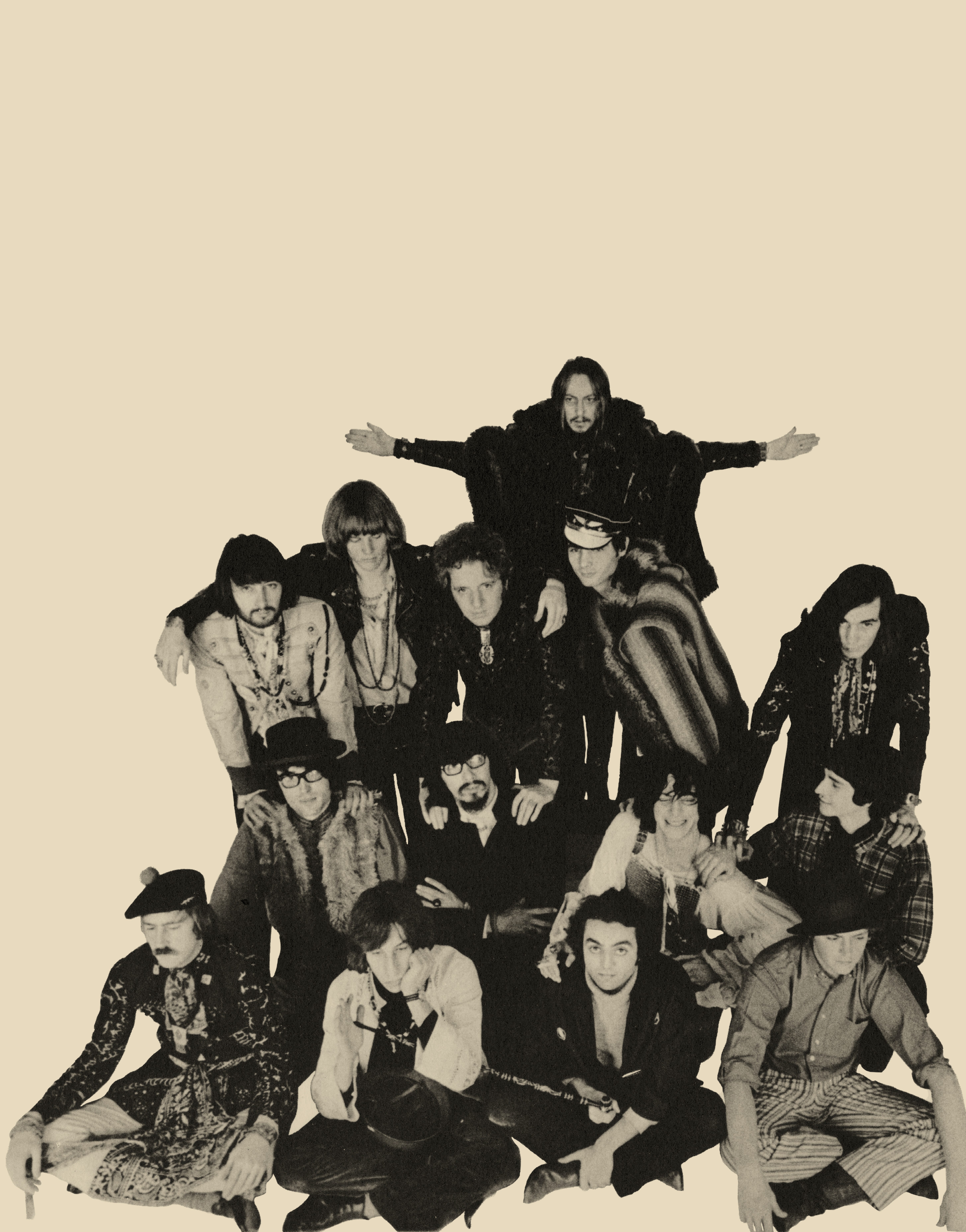
Devil and crew, as seen in Saga de Xam.
                     /_______//__///__//_______//
                     |///////||//|/|//||//_////|/
                     |//_____||//|/|//||/|_|///|/
                     |/|_____/|//|_|//||///////|/
                     |_____//||///////||//_///|//
                     /_____|/||///////||/|_|///|/
                     |_______||_______||_______|/
                     /_______//_______//______///
                     |///////||///////||////_/|//
                     |//_____||///////||///|/||//
                     |/|_____/|///////||///|_||_/
                     |_____//||//////_||////__//|
                     /_____|/||/////|_/|///|//|/|
                     |_______||_______||___|//|_|
                     /___///_______//_______/////
                     |///|/|//_////||///////|////
                     |///|/|/|_|///||////___|////
                     |///|/|///////||///|___/////
                     |///|/|//_///|/|////___|////
                     |///|/|/|_|///||///|___/////
|___|/|_______||_______|////In 2022, the French comics industry’s prevailing ambivalence on representations of sexual transgression was shaken when the artist Bastien Vivès was dropped from the Angoulême Comics Festival and investigated for promoting incest and child pornography.
I asked Christian for some examples of his most admired comics creators. His response, in full:
If I have a little space to name a few, I would give the following names today (tomorrow the list might be different). For very old authors, I would cite Gustave Verbeek, whose “Upside-Down” strips are a unique gem. I would like to work on this author one day. And then George Herriman, for the madness of his Krazy Kat. And also Alex Raymond, perhaps the first true virtuoso of comics. For those of my generation, who marked my adolescence, there is Druillet, Moebius, Alberto Breccia—the absolute master of expressive black and white—but also Albert Uderzo (of Astérix) and Fred (of Philémon). For more recent authors, I add Chris Ware (of course); Pierre Duba, who remains unknown to the main public, but whose graphic novel Racines, is, like Saga, a unique gem that opens new paths; and Jens Harder, with his albums Alpha and Beta. I’ll also add Chantal Montellier, for whom I have great admiration: she was one of the first real political authors, and she has profound things to say (Odile et les crocodiles, Shelter, Andy Gang). Also Alison Bechdel (Fun Home), Emil Ferris (My Favorite Thing Is Monsters) and Posy Simmonds (Tamara Drewe, Cassandra Darke).