
DIARY // huligani highlights
“onetime outsider cachet shading into states more detectibly pathetic”

Bună ziua folks.
This week I’m coming to you from the knotty, overleveraged central cordage of a tangle of ongoing research/writing/hanging out/life projects, including but by no means limited to:
⤅ January’s “Lettrist Film” series at Anthology Film Archives, comprising screenings of four works from the Romanian-French avant-gardiac Isidore Isou and his crew of willfully jerky scandalmonger legends, of whom I’m on the record as being a, let’s call it “conflicted obsessive”;
⤅ the accompanying exhibition on Isou and Lettrist books and printed matter, on view now through May 2 at NY’s Center for Book Arts;
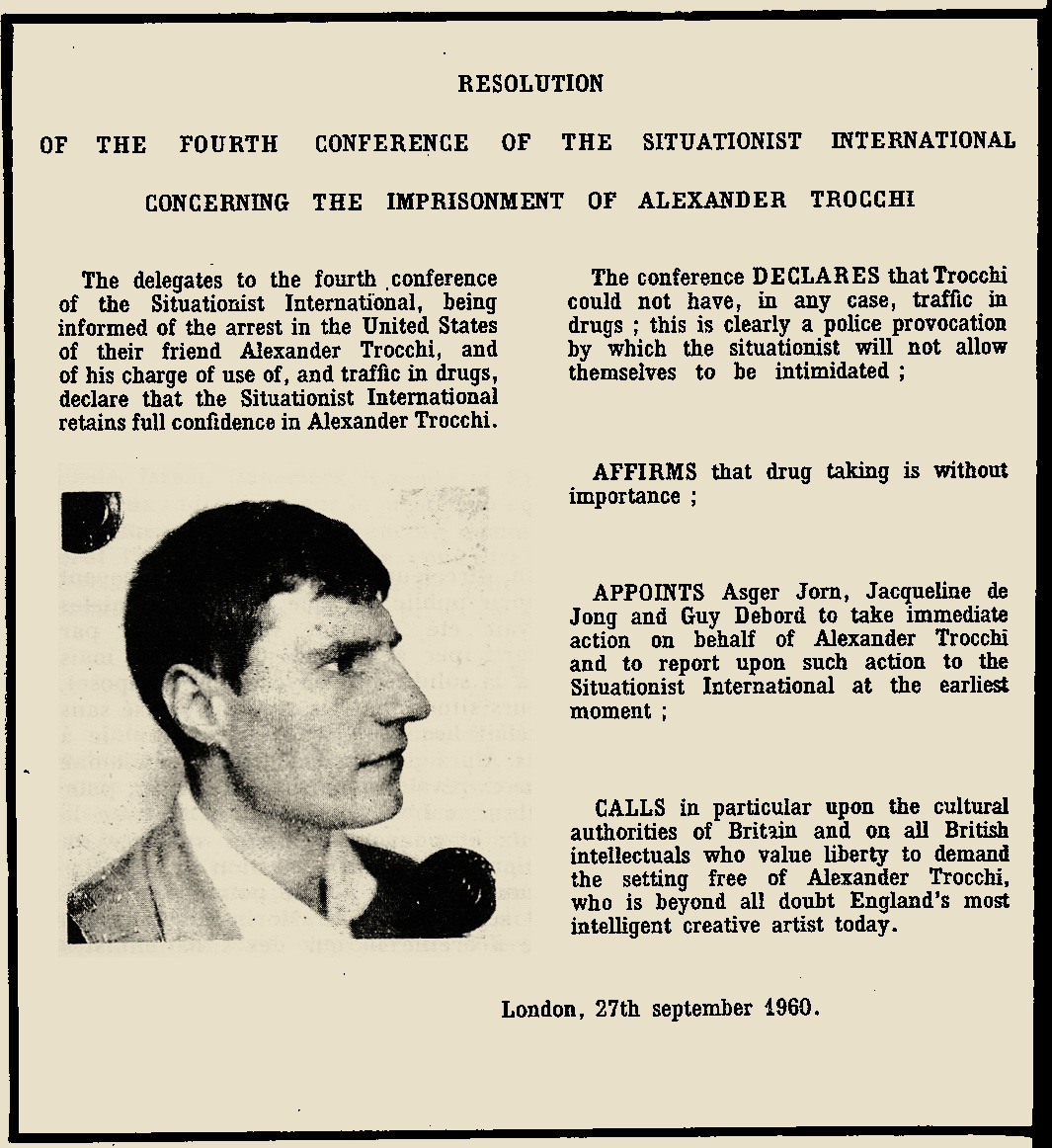
⤅ last night’s New York University–sponsored film screening and discussion of the life and legacy of Alexander Trocchi--he of the post-Lettrist formation the Situationist International among a million other things (an event which I’m only pretending has already happened as I write this); and
⤅ my visit to Bucharest next week, which will cap a year of madcap language study, familial archival exploration, and notarized signatures on government forms (we’ll talk about this one later).
Anyway, some common features: youthful bluster and bullshitting, rank hooliganism (or, if you’re a post-Eliade Romanian youth, huliganism) as both symptom of and remedy for long-term statelessness, onetime outsider cachet shading into states more detectibly pathetic... and yes, OK, a bunch of crucial art moves. A nice feature, that last part, of what is otherwise a lowkey stressful time. See below.
Orb bros, stand and be counted.
I missed the second half of Anthology’s program (though Chad forewarned that Saturday’s event would feature lots of audience bullying, which obviously has a certain Dick’sian je ne sais quoi), but I did manage to hit the screenings of Isou’s all-time great cinematic essay/noise set Traité de bave et d’eternité and, what’s even sicker, Gil Wolman’s L’Anticoncept, the ballyhooed early masterpiece by the right-hand-man of Guy Debord’s schismatic Lettrist International group. I have wanted to check L’Anticoncept out via a non-Ubuweb delivery system for a long time now, and it’s a testament to how reliably Anthology hooks it up (it’s my favorite place in NYC, no contest) that their screening—which featured the requisite weather balloon orb in place of a projector screen—was a packed house affair, though I did hear tell of walkouts, which is honestly equally laudable. Audience members got printed copies of Wolman’s monologue soundtrack, though the evening’s strobelit character meant there was no point trying to follow along. And honestly why bother, when it’s at least 75% about the varispeeded tape FX and maybe another 5% about the untranscribable puking sounds? Anyway, thanks to AFA, thanks to Gil, and thanks to the lifepath that’s got me entertaining stuff like this as a valid Thursday night outing. More on Monsieur Wolman before too long.
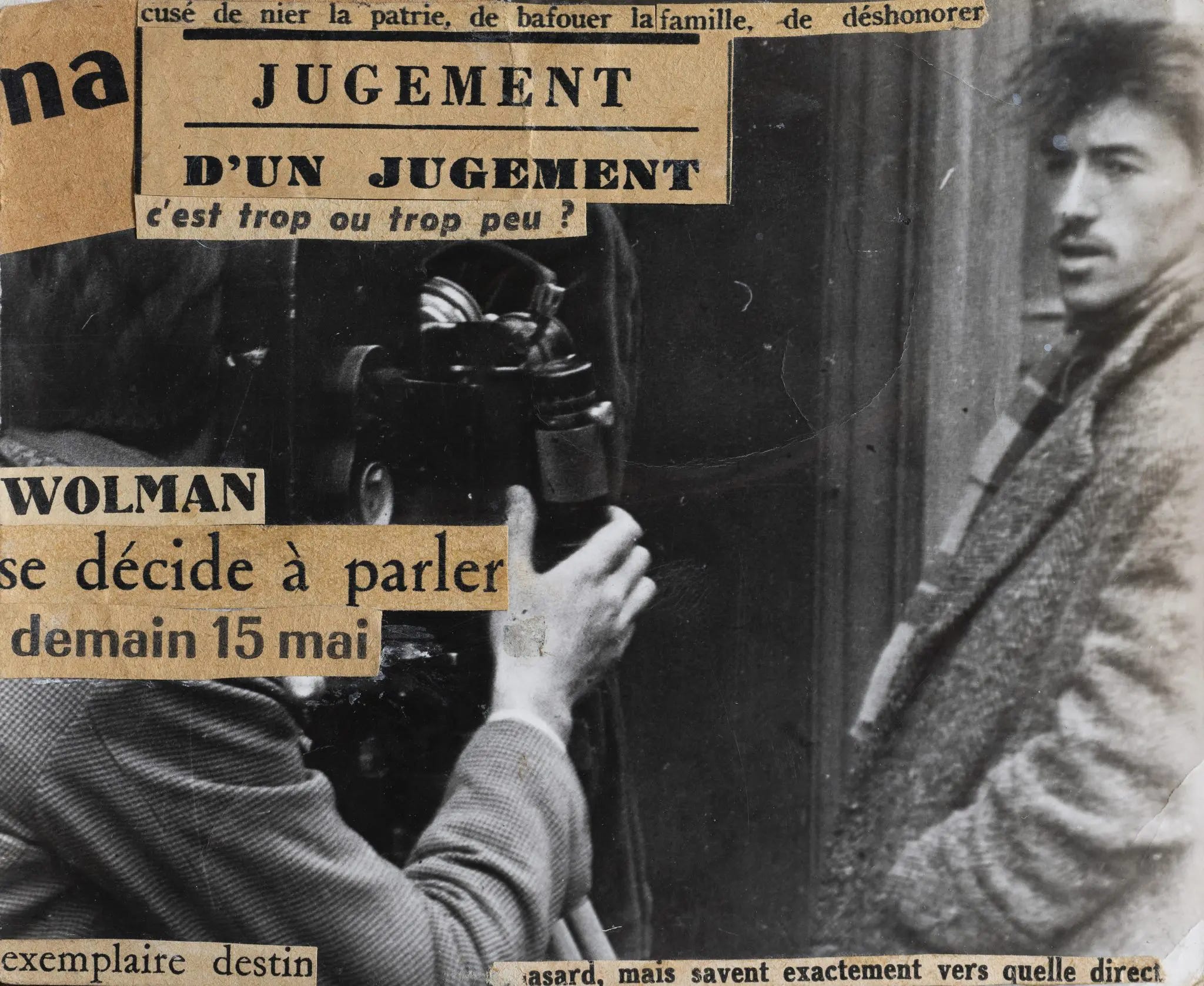
Guy Debord’s Métagraphie (Portrait de Gil J Wolman), 1954.
Meanwhile, some very quick Trocchi talk before—to drop the pretext that I’m not schedule-sending this post from last night—I pack up and head to the event in his honor:
While I can’t reliably say where and when I first encountered Trocchi’s work, it was definitely via his writing, well before I had gotten oversteeped enough in this countercultural lineage stuff to think of him as a sui generis / mostly tragic figure whose life bridged several otherwise far-flung postwar undergrounds. In my case, I read Young Adam, and probably must have known something about Trocchi’s collaborations with Girodias’s Olympia Press, which in turn I would’ve stumbled on via a heavy adolescent repping of all things Burroughs; obviously, reader, you know how this works from whatever analogous routes you’ve taken to reach your cozy redoubts of art obsession. Mostly it feels worth reconstructing the paper trail, though, because of how this conception changed later on, when I discovered—via a series of odd jobs on the margins of archival preservation and the rare book world—that Trocchi in particular had become a bankable signifier for traders and collectors of avant-garde cultural detritus. I worked jobs, in other words, in which Trocchi’s works served as fetish objects, artifacts coveted mostly (or entirely) because of their drug content and shelved alongside stuff like De Quincey, Baudelaire, and the Ace Double paperback of Junky. A bummer, somehow—in spite of the fact that, duh, we all know this materialist tendency is a part of the deal—but also a valuably unromantic object lesson in the means by which countercultural history is agreed on, and the relative estimations in which we place its creators. Which is all just to say that these days, I don’t quite know how to feel about big Alex Trocchi; here’s hoping tonight complicates the picture that much further. Stay tuned.
 ,_______________________________________,
/   HHH*                          *HHH   /.
`---------------------------------------" :
| +              XLII  90             + | :
|             .____________.            | :
|       .++.  |######\  /##|  .++.      | :
|       +  +  |######/  \##|  +  +      | :
|       '++'  '------------'  '++'      | :
|                                       | :
|                                       | :
|      /'''''''''''''''''''''''''\      I :
|     /     o       0         o   \     I :
|+   / O                         O \   +|,'
`---------------------------------------`
The term ‘hooligan’ or in Romanian ‘huligan’, was used in the 1930s Romania by right-wing extremists and fascists to describe undesirable people, among them, the Romanian Jews.
The term penetrated the cultural world in 1935 when the Jewish Romanian writer Mihail Sebastian published “How I Became a Hooligan” where he addresses the absurdity of the hate directed at him, defending his right to be both Romanian and Jewish, and analyzing the ‘hooliganism’ of the intellectual antisemitism of the time.
I believe Isidore Isou was familiar with Sebatian’s book and going to Paris in 1945 he adopted the term to reflect contemptuous attitude towards all previous art movements. It was aimed especially at the patron saints of Dadaism and Surrealism, Tristan Tzara and Andre Breton respectively, as a negation of Dada and Surrealism influence on Lettrisme.
The recent incarnation of the term ‘huligan’ was Norman Manea’s 2003 book “The Return of the Hooligan” where he describes the persecuted, marginalized, or maladjusted intellectual in an extreme political context. Manea's ‘hooligan’ represents the exiled, misfit intellectual who survived both the Holocaust and the communism.
Feeling some feelings (mostly longing) irt being transported to an Anthology screening. Weather balloon?!?